The native bees of Oatley Park
April 2026
With the close of the bee season…
The number of bees found within the park decreased over the months of March and April, even on days that I started to recognise as good days to find bees. This was likely due to the increasingly cool nights in Sydney, with overnight temperatures dropping to around 12 degrees Celsius.
Only one species of native bee in Sydney is eusocial (as in, living in a hive with a queen, workers and drone), with the rest of them living either solitary or communal (where female bees shares a nest entrance with other females). It is likely difficult for many our native bees to sustain themselves right now with few flowering plants around the park. During April and May is also the time when there is the large honeyeater migration of birds from the south and southeast of Australia passes through Sydney towards the north, with estimated hundreds of thousands of birds participating in the migration.
I wanted to make a nice depiction of the range of different bees that I’ve found this season. Searching through my hundreds of photos of bees, I made a collage of the different bees, grouping together different families together. The Halictidae (commonly called sweat bees) are in the top left, the Apidae are in the top right, and the Colletidae are grouped up at the bottom.
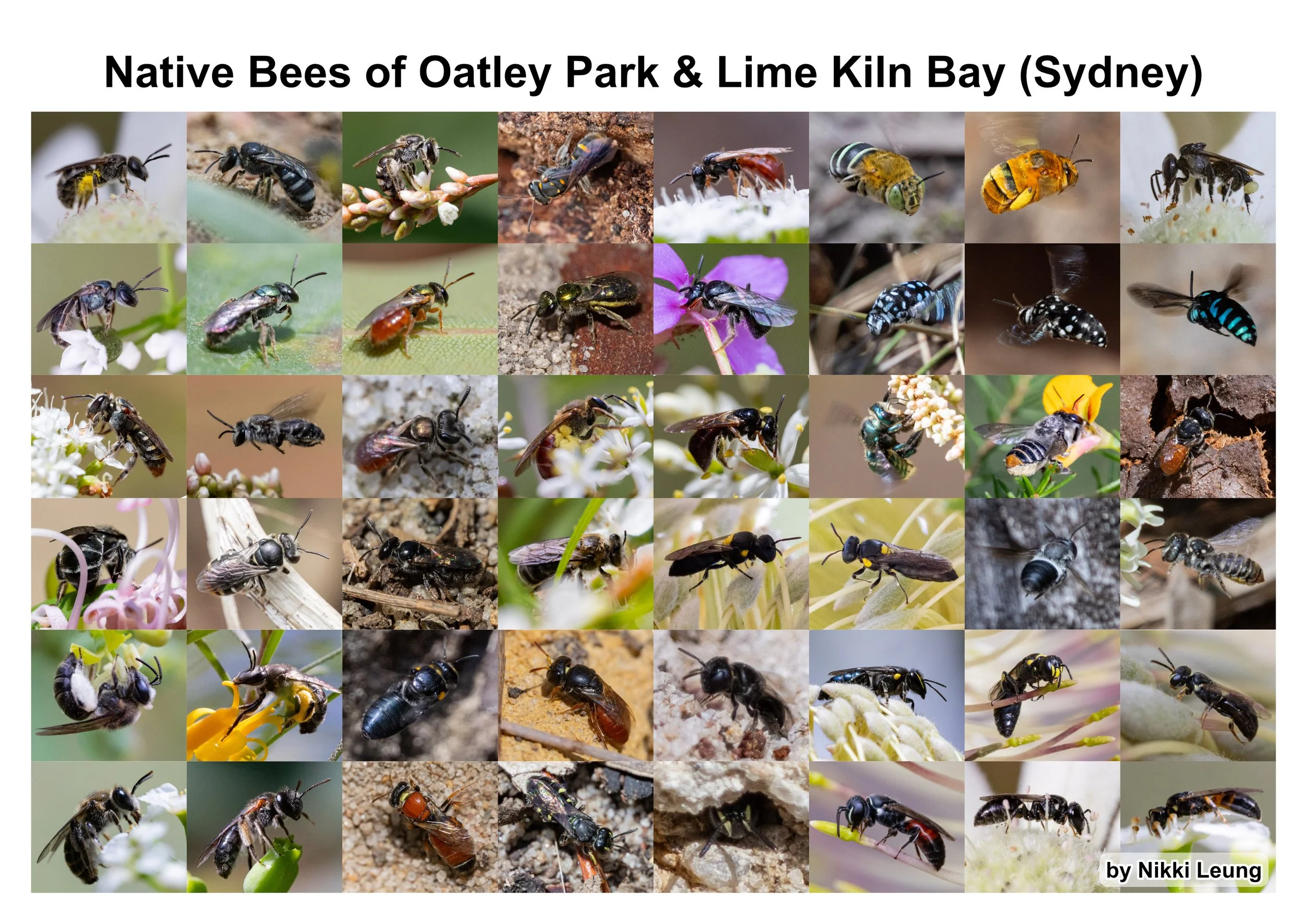
A collage of bee species that I’ve photographed within the last several months in Oatley Park and Lime Kiln Bay
I was able to confirm that 47 of the 48 photographed were definitely female (as female bees have several recognisable traits, including all of them having 12 antennae segments). The bee that I didn’t have enough information on was the Chequered Cuckoo Bee, thyreus caeruleopunctatus, which I was only able to get a few in-focus photos and I only saw two or three times.
Some of the bees looked different, but it will take time and research for me to confirm them as definitely different species. With the help of iNaturalist I was able to get confirmation of 29 bees identified to species level, but it’s very complicated for many of them since I didn’t want to capture and examine them under a microscope.
Written by Nikki Leung, 2026