Oatley Park and the search for Native bees
April 2026
Starting the project
In October 2025, I was feeling very restless after a bunch of stuff happened, and I wanted to start a new project. I had just finished my previous project which was searching for and photographing some Southern Emu-wrens, which I had been hoping to find for many years. One of the common topics when talking with people around me was the absence of European honeybees in the environment, which I had noticed as well in my birdwatching compared to previous seasons. I had known that we had many native bees in Australia, but I couldn’t find that much local information about them relative to the commonly estimated number of 1700+ species of Australian bees.
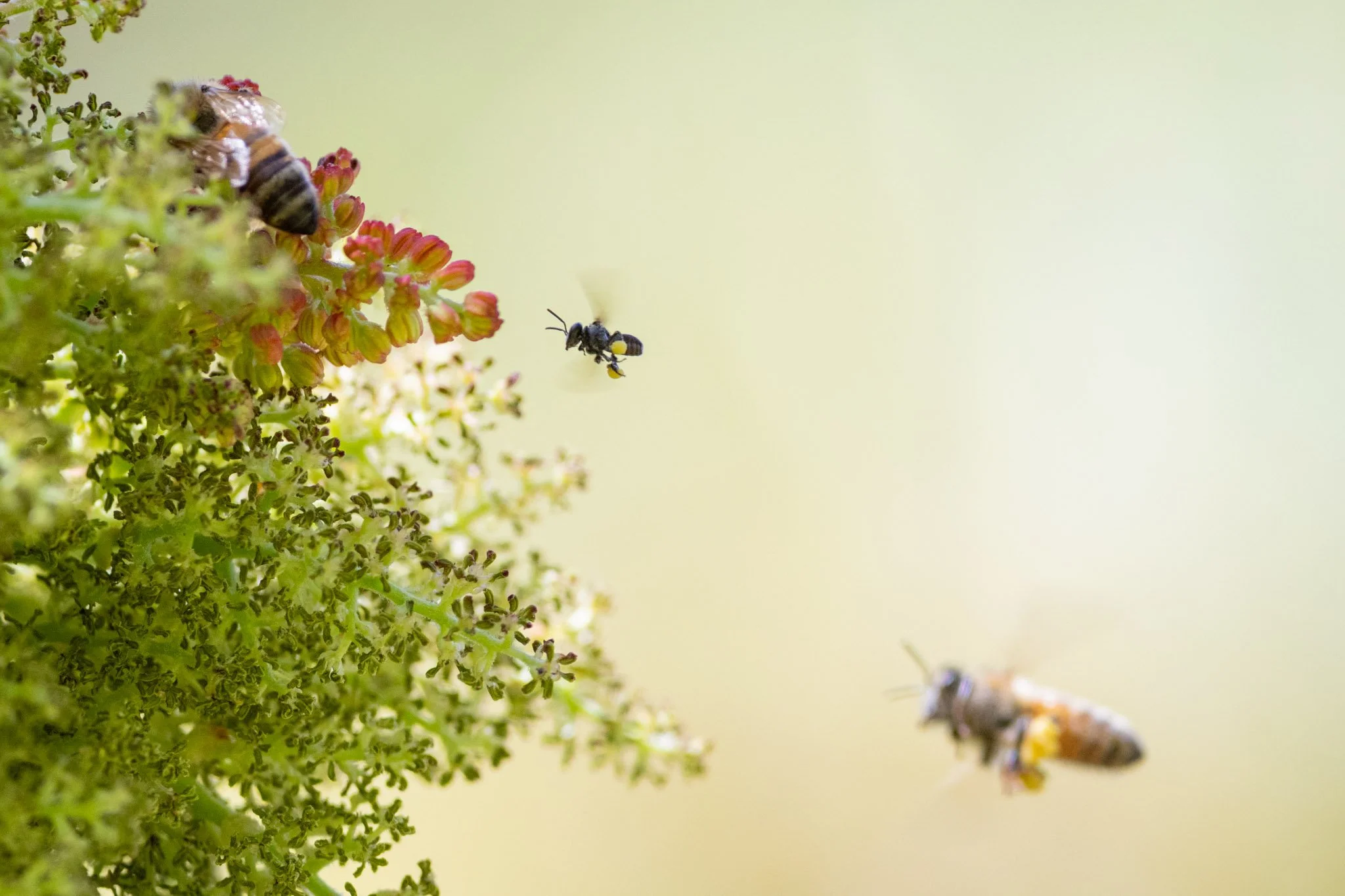
Tetragonula bee, next to some European honeybees, on 6/10/26
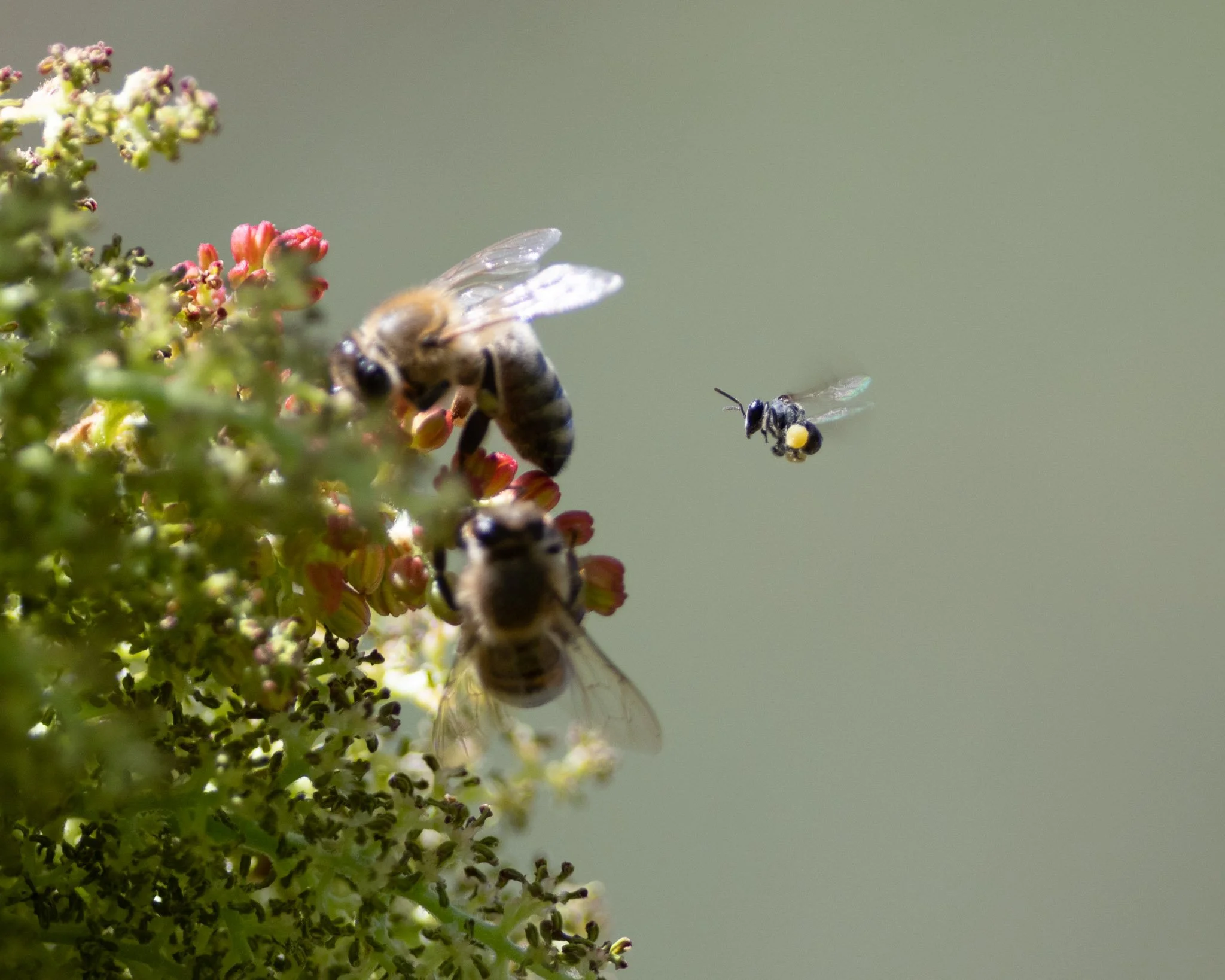
4mm Tetragonula bee, next to some European honeybees, on 6/10/26
A chance encounter with some Tetragonula bees in Lugarno really kickstarted my interest in the project. Tetragonula are the only native social bee living in Sydney, as in they live in established hives with a social structure comprising of a queen, workers and drones. They are the only native bee down in Sydney that makes honey, as the hive needs the honey to survive the winter months. Every other native bee species locally are solitary bees who have male and female bees, don’t make honey, and the female bees take care of their own nests and offspring.
I turned to iNaturalist as a citizen science database to see what had been recorded in Oatley Park and Lime Kiln Bay, and by chance there was a project already in the area demarcating the boundary of the park. Unfortunately, only 7 species of native bees had been recorded at the time, and only once each.
From my other research, most of our native bees were much smaller than the European honeybee, and that made them harder for people without the right equipment to document them. On top of that, searching on iNaturalist, it looked like there were fewer people on this side of Sydney documenting to the platform, with many more people in the Inner West, Eastern Suburbs and the North of Sydney submitting observations. There had only been 108 species of insects recorded within Oatley Park and Lime Kiln Bay at the time, which I was sure was undercounting quite a lot.
It took me a bit to get started and organised, and I didn’t get regular trips rolling until the end of October. I did not end up seeing my first bee in Oatley Park until November 9 which was a reed bee of genus Exoneura on a Pink Spider flower, grevillea sericea. She was extremely cute with her small size, which was about 5mm long, and the pink pollen grains caked onto the scopa on her hind legs. Many native bees carry pollen on scopa, dense hairs that the bees stick dry pollen onto like a brush, rather than the flattened corbicula (a pollen basket) commonly found on Tetragonula stingless bees or European honey bees, where wet pollen is compacted and loaded onto the leg in clumps.
One of the most important things when photographing living animals in the wild is noticing and learning their behaviours, their rhythms, their preferences, their habitats. I definitely struggled with this at the beginning, because I had to first learn how to recognise which insects are bees by sight. When there are many things moving in the same area, focus and prioritisation are key to getting good photos.
Native bees have a huge range of appearances, coming in a range of colours, shapes, and sizes. Some of them are hairy, and some have little hair. Some are metallic, others are just brown or black. Some carry pollen on their legs, some of them carry pollen underneath their metasoma, or both, but some of them will swallow the pollen to carry within themselves. Male and female bees also look and behave quite differently too, with the female bees usually being the more recognisable member of their species.
Learning to recognise bees was made a bit more difficult in this environment by a large diversity of insects in this environment that mimic bees or wasps in appearance. There were also many wasps which are close relatives to bees, and so they have features that look similar to bees or they have similar behaviours to bees, like how they fly or how their burrows look.
The documentation process involved only taking photos with my camera and macro lens or a telephoto lens, and using natural light only (no flash or artificial lighting). I tried to minimise my impact on the environment around me by not touching my subjects and remaining on marked trails. This was also an important safety consideration as you don’t know what’s hiding underneath vegetation in the bush. I also did not trap/capture any of the insects in order to photograph them, although I did document the remains of some as well as predation events.
Overall, this project was limited in that it relied on me noticing my subjects, and then being skilled enough to photograph them. I certainly missed many things on my trips out and about, especially those that camouflaged well in the environment, things that were small and I struggled to see clearly, things that moved very fast or unpredictably, or things that were too far away.
In my next installments of this blog, I’ll be talking about the different native bees in Oatley Park that I’ve found so far, as well as many of the interesting things I’ve been able to document through my journeys. As of the end of March 2026, I have logged over 300 hours in the park for this project and have walked over 300 kilometres within the park, which has allowed me to learn a lot about the things that live within it.
Written by Nikki Leung, 2026
Photos by Nikki Leung, 2025